Olongapo SubicBay BatangGapo Newscenter

Saturday, October 01, 2011

$500-m Masinloc Coal Plant expansion up

AES Corp. of the US has committed to expand the 600-megawatt Masinloc coal-fired power plant in Zambales province by an initial 300 MW at a cost of $500 million.

Andrew Horrocks, country manager of AES Philippines, told reporters at the sidelines of a conference Thursday that the company was waiting for government permits to go ahead with the expansion

“We are on expansion stage. We are going through the process, getting the environmental clearance certificate and final stage of permits,” Horrocks told reporters.

Horrocks expects to receive approval of the Masinloc permits by November. He said the coal plant expansion received strong support from the local communities.

“We have very good relationship with them, no problem with that,” he said.

Horrocks said the company hoped to start construction soon.

He said the company sought approval to expand the power plant by 600 MW.

“The first 300 MW [is] roughy around half a billion dollars. Our permitting is for 600 MW but our view is 300 MW by 2015,” the AES official said.

Labels: , , ,

Thursday, September 22, 2011

SBMA board to impose limit on environmentally sensitive projects

“Through a board resolution, the (Subic Bay Metropolitan Authority) Board of Directors will declare whether or not the project is environmentally sensitive, or is in compliance within the parameters of acceptable levels of emissions.”

This sums up the decision of the board, SBMA chairman Roberto Garcia said, as SBMA aims to implement stricter standards to safeguard the Subic Bay Freeport from pollution.

The action ensures that all projects, which are to be built inside the free port zone, particularly environmentally sensitive projects (ESPs), are acceptable to various stakeholders.

ESPs are projects that are determined to emit pollutants, which may have a potential impact on the natural resources, and the health of the people living or working in the area.

These pollutants include emissions, effluents, sound or visual from the proposed project that may deteriorate the health of the people, the forests and the animals living there, the bay waters, creeks, ground water, and air, among others.

Under this system, if the proposed project is considered an ESP, the SBMA Ecology Center will independently verify all of the project pollutants, the natural resource impacts, and extent of the proponent’s mitigating measures. All data gathered will be presented to the SBMA Board.

Stakeholder groups, consisting of representatives or officers of housing areas, Freeport workers’ associations, and the indigenous people’s tribal council will be invited to public consultations on ESPs where inputs about the results of the verification process will be presented.

Based on the evaluation “of the totality of acceptability ratings from the various stakeholders of the Freeport,” the SBMA Board shall declare whether or not the project is socially acceptable.

In any case where the project is declared not socially acceptable, the proponents will be advised to redesign the project or its mitigating measures to meet a level acceptable to stakeholders. Meanwhile, its permit to operate will be withheld.

“This way, the stakeholders are given a sense of participation in truly preserving the unique environmental feature of the Freeport, which is one of the major attractions of Subic’s tourism industry,” Garcia said.

The law that created the Freeport and the SBMA mandates the latter to protect, maintain, and develop the virgin forests into a national park by implementing the rules and regulation of the Department of Environment and Natural Resources (DENR).

The issuance of stricter standards, through the implementation of a policy on ESPs, will help the SBMA in realizing its mandates of protecting and preserving the environment.(by Allen M. Villa-PIA 3/SBMA PRD)

Labels: , , , , , ,

Wednesday, September 21, 2011

Subic Coal Plant Proponents explains project to Olongapo leaders

RP Energy showed up in the Olongapo City Department Head's meeting yesterday to shed light on the proposed coal-fired power plant project. City Councilors and Barangay Captains are also present in the meeting.

Mayor Gordon showed slides of the beautiful Olongapo, a video of Pres. Clinton asserting the preservation of Subic's prestine environment, and made it very clear to the presentors that Olongapo City opposes the coal plant project in Subic Bay.

Nonetheless, RP Energy was allowed time to explain, for the city's leaders to have the chance to ask questions and let the project proponents hear the oppositor's concerns.

City Administrator Ferdie Magrata, Dr. Art Mendoza, Councilor Perez, Ed Piano and more than a dozen more residents were able to say their piece and ask questions.
Magrata asked if its true that RP Energy had already started the construction and if indeed this truly is a "done deal" as national government officials are saying... to which RP Energy officials replied in the positive. "By law, the concurence of Olongapo City is not required, but we are here because we also wanted your support and we are mandated to inform the people of the on-going project."

Most noteworthy in yesterday's presentation is the revelation that Zambales Gov. Ebdane, Subic Mayor Khonghun, the Captain of Cawag, DENR, PENRO, CENRO, EMB, the Provincial Fisheries Council have already signed a Memorandum of Agreement as members of the monitoring team with SBMA and RP Energy pertaining to the coal plant project.

Labels: , , , , ,

Monday, August 15, 2011

Subic Chamber President released a letter on SBFCC position and update on coal power plant

Here-under is Prof. Danny J. Piano's mail regarding the chamber's position on coal power plant and update for our info:

The issue about the Redondo coal-fired powered plant has again reared its head so I think it is best that members be informed of what went on and its present status. Here’s a brief historical timeline:

28 Jul 2006 – Memorandum of Understanding (MOU) between SBMA and Taiwan Cogeneration Corp (TCC) regarding the latter’s proposal to build a coal-fired power plant

11 Aug 2006 – letter by TCC regarding proposed location of ash pond

4 Dec 2006 – SBFCC letter to SBMA Administrator Armand Arreza (ACA) opposing the Redondo coal-fired power plant

Dec 2006 – Environmental Impact Statement (EIS) submitted by TCC

22 Dec 2006 – SBMA Ecology Center consultation meeting with the Subic Bay Resorts Association (SUBRA) and later, with SBF locators

24 Jan 2007 – Manifesto from the Alliance for the Preservation and Enhancement of Subic Bay

26 Jan 2007 – Subic Coal-Fired Power Plant Presentation to Locators by TCC

4 Apr 2007 – SBMA’s Ecology Center issues Environmental Compliance Certificate (ECC) to TCC

7 May 2008 – DENR's Environmental Mgt Bureau's (EMB) Public Hearing at Cawag Elem School, Subic, Zambales (there was another one conducted at around this same date at the Aristocrat Restaurant)

12 Jul 2007 – SBFCC letter to DENR Sec. Angelo Reyes, re: opposition to coal-fired power plant

26 Jul 2007 – SBFCC letter to newly appointed DENR Sec. Jose Atienza Jr, re: opposition to coal-fired power plant

27 Dec 2007 – SBFCC letter to VP Luis Aboitiz, re: opposition to issuance of ECC to TCC

12 Mar 2008 – Danny Piano’s report to the SBFCC regarding the circulating fluidized bed technology based from a similar TCC power plant in Taiwan

14 May 2008 – SBFCC’s letter to DENR-EMB's Julian Amador opposing the plant

22 Dec 2008 – DENR, which essentially "voided" SBMA's ECC, issues their own ECC to the Redondo project nonetheless

6 Oct 2010 – HHIC (Hanjin) writes SBMA regarding their concern about possible effects of dust from the power plant to their painting operations

14 Dec 2010 – Redondo Peninsula Energy’s (RP Energy) replies to HHIC saying essentially there is negligible or no effect

28 Jun 2011 – Pres. Aquino showed support to coal-fired power plants when he inaugurated a plant in Cebu and said, "While the power plant we are inaugurating today does not necessarily produce renewable energy, it does comply with the Clean Air Act”

22 Jul 2011 – Meralco PowerGen Corp. takes majority stake in the Subic Bay 600-megawatt coal-fired power plant. Secretary Jose Rene Almendras of the Department of Energy who witnessed the signing said that the Philippines will continue to rely on coal as a major fuel for power generation

The Subic Bay Freeport Chamber of Commerce has been at the forefront of this issue and has submitted several position papers regarding our opposition to the Redondo coal-fired power plant. The SBFCC position has not changed.

Unlike some people who today profess knowledge about the issues concerned and what went on, we were actually there since the start. Since 2006, we spent, mostly on personal time, hundreds of hours researching the facts; attending public hearings; and gathering, studying, and analyzing documents we can get our hands on.

While the Subic Bay Freeport obviously has a need for more reliable and cheaper electricity, we are also a premier tourism destination. But, we do not want to be fear mongering as others do since the plant that will be built is based on the new and much cleaner circulating fluidized bed (CFB) technology; it is a case of NIMBY or not-in-my-backyard in our case.

Some SBF manufacturers who in the past did not care much about the power plant when electricity was more reliable and cheaper have now expressed concern due to the continuing rise of electricity rates. Studies by the Philippine Chamber of Commerce and Industry (PCCI), of which the SBFCC is a member, have shown that unless something is done, the Philippines will have electricity supply problems. Also, that the Philippines now have the highest electricity rate in Southeast Asia. It also said that we need the right mix of renewable but expensive energy and non-renewable but less expensive energy like coal. It is a necessary evil, the same as our gas-guzzling cars and SUVs. It is analogous to the reason why we are not all driving hybrid cars—because we cannot afford them.

In short, the cause for concern of many manufacturers is not without basis, as do the concern of tourism-related companies about the potential effects of the power plant to the environment and tourism. It is a case of being caught between a rock and a hard place.

But, are we really going to get cheaper electricity rates from the Redondo plant?

Just today, another newspaper release came out from the Philippine Daily Inquirer titled, “Subic locators not primary beneficiary of coal-fired power plant.” If this is true then we won’t get much of the cheaper electricity that we are hoping for in the first place. Fortunately, it is not entirely accurate. The nodal billing and open access system that will become effective nationwide late this year will take care of that. Basically, the cost of transmission will depend on how close one is to a power generation plant. The closer we are to one, the cheaper the transmission cost. Not to mention the plan to provide generation cost discounts to Freeport locators if the previously proposed 69kv line for a 50MW block to the Freeport mainland is found to be impractical.

In any case, the stark reality is that the Redondo plant project is going to push through. It already has, in fact. The project proponent has already started its development which it expects to complete by 2015. Even as we have not changed our position, even if we have been fighting it since 2006, the reality is we lost this fight. Some organizations and people who were not there during the fight when it was happening are now making it appear to be the gladiators—when the fight is all but over. The past Arroyo administration has approved the project more than two years ago. The present Aquino administration is for it, too, because of the impending power crisis and since it complies with the strict Philippine Clean Air Act in the first place.

Friends, we cannot fight a fight that is over. While hope springs eternal, we must also be pragmatic. What your Chamber is now trying to achieve relative to this project is to make sure that appropriate monitoring systems are put in place and that the visual impact of the power plant to tourism is minimized. I had made a suggestion to the project proponent that the 24/7 emission display on their computer monitoring system be made available to the public via a website. This way, anybody can monitor the emissions and there will be transparency. I look forward to winning this one at least. Strict monitoring is very important and is the reason why some coal-fired power plants like the one in Oahu, Hawaii and Redondo Beach, Los Angeles, California are able to co-exist with both commercial and tourism establishments. For this reason, we will lobby to be part of the authorized monitoring team as well.

I hope I have provided a summary of all the information we have on hand relative to the Redondo power plant project. You may agree with me or not on some or all of it but, as your president, it is my duty to present it as it is.

Sincerely,

Prof. Danny Piano

President


= = = = =


Reply of Alex Corpus Hermoso predalex@info.com.ph to Danny's letter


In HAWAII:
The Hu Honua plant emit more particulate pollution than many coal plants. The plant also emit between 200 and 300 tons of carbon monoxide per year, which is treated by EPA as a proxy for organic pollutants like formaldehyde. The plant will emit over 6 tons of formaldehyde and 5.74 tons of benzene per year.
Partners For Policy Integrity
Author: R. Wiles Published April 22,2011

In 2006, Hawaii's sole coal-fired power plant produced 1.6 million tons of CO2, 900 tons of sulfur dioxide, and 1,000 tons of nitrogen oxide;
This coal-fired power plant was responsible for 7.6% of the state's total CO2 emissions

Along Delaware canal 44.8% colorectal cancer
In Kenton 22.4% above average for ALL cancer cases
In Millsboro 29.8% for lung cancer
In Wilmington 21.1 % for prostate cancer
by Cris Barrish , The News Journal

Fluidized bed combustion (FBC) technology is not Taiwanese Technology
FBC boilers was first used in eastern Pennsylvania in 1987.
FBC burner are more complicated than normal pulverized coal power plants
Waste coal has higher concentration of mercury than normal coals ( 4X than bituminous coal) PAHs from FBC are more than normal coal burners due to their use of limestone injections , their lower combustion temperature range , the low rank coal being burned and the higher levels of chlorine and sulfur in the fuel. The addition of extra limestone can promote the formation of PAHs in the FBC system. The total PAH emission increases with an increase in sulfur content of coal. Some ash particles can still pass the Electrostaticprecipitators and transported into the atmosphere. Treatment of FBC ash with N2O4 increased its mutagenic potency (cancer -causing property) by as much as 3200 times .CFBC plants contain PAH that readily cause bacteria to mutate.

Mike Ewall Energy Justice.net
April 2008

Labels: , , , ,

Wednesday, June 29, 2011

Meralco acquires 2 Subic plants, will build coalfired plant here

Manila Electric Company (Meralco) is acquiring a majority stake in an Aboitiz Power Corporation joint venture that is building two 300-megawatt independent coalfired power plants in the Subic Bay Freeport Zone.

In separate disclosures to the Philippine Stock Exchange, the two firms said Meralco’s wholly-owned unit Meralco PowerGen Corporation will invest in Redondo Peninsula Energy, Inc. (RP Energy).

RP Energy is a 50-50 joint venture company formed by AboitizPower’s wholly owned subsidiary Therma Power, Inc. (TPI) and Taiwan Cogeneration International Corporation (TCIC) for the construction and operation of the proposed Subic Bay coal-fired power plant.

MPGC is expected to take a controlling interest in RP Energy, with TPI and TCIC will be diluted and end up equally owning the remaining stake of less than 50 percent.

Commercial operation of the proposed Subic Bay coal-fired power plant is projected to start in 2014. The plant is expected to augment the power supply of the Luzon Grid.

Meralco earlier said that its entry into power generation is part of its over-all strategy to assist in ensuring efficient, adequate and reliable electricity at cost-competitive rates.

The utility said that the potential partnership with TCIC and TPI will add to Meralco’s competitive electricity supply portfolio sourced from existing generating plants and from new highly efficient baseload, midmerit and peaking power plants, which MPG is putting up to meet customer requirements.

Meralco reiterated its commitment to existing long time and new customers in offering a wide range of valued products and services as a total energy solutions provider.

Meanwhile, in a separate disclosure, Meralco said it has priced P5 billion 7-year and 10-year fixed rate notes with a group of primary institutional lenders with The Hongkong and Shanghai Banking Corporation Limited acting as the sole lead manager and bookrunner.

The notes will be issued on June 29, 2011 with the proceeds from the facilities to be used to finance Meralco’s capital expenditures and for general corporate purposes.

The 7-year and 10-year notes were fixed at a yield of 6.2692 percent and 6.8900 percent respectively.

The notes fetched a credit spread of 20 and 21.12 basis points over the relevant respective 7-year and 10-year benchmark rates, the lowest priced by the investor market for a peso capital market transaction by a corporate issuer in recent history.

The notes issue was 2.35 times oversubscribed from the original announced issue size of P3 billion with books reaching P7.05 billion in orders, thus allowing Meralco to exercise its oversubscription option of P2 billion. By JAMES A. LOYOLA - mb.com.ph

Labels: , , , , ,

Wednesday, August 04, 2010

Aboitiz Power, RP Energy to continue power-plant construction in Subic

Aboitiz Power Corp. and its Taiwanese joint venture partner, Redondo Peninsula Energy Inc. (RP Energy), are now pushing through with the construction of a 300-megawatt coal-fired power plant project in Subic Bay Freeport Zone.

Aboitiz Power told the Philippine Stock Exchange Wednesday that after RP Energy revisited the demand-and-supply situation of power in the Luzon grid, RP Energy said it would be "economical" to continue the project.

"The RP Energy management now believes that the economic environment makes the Subic coal project more feasible," Aboitiz Power said in a regulatory filing.

Earlier, the board of Aboitiz Power deferred the project timetable for this project, saying the impact of the US recession could push back power demand.

Aboitiz Power executive vice president Luis Miguel Aboitiz said RP Energy will source its coal requirements from Indonesia.

"The cost of the project has not been determined because we have not yet signed a contract," Aboitiz said.

The proposed 300-MW coal-fired power plant — which will utilize clean coal technology — will be built on a leased Subic Bay Metropolitan Authority property near the Hanjin Shipbuilding facility.

The coal project was earlier estimated to cost at around $450 million to $500 million. —JE, GMANews.TV

Labels: , ,

Friday, January 16, 2009

Aboitiz suspends construction of 300MW coal plant in Zambales

The intended construction of the 300-megawatt coal plant in Subic Bay, Zambales has been suspended by the Aboitiz Group and its partners.

In a lunch briefing, Erramon Aboitiz, president and chief executive officer of Aboitiz Power Corp., said the decision on whether to push through or not with the development of the coal plant will be based on the review they will conduct.

"We have pushed back our notice to proceed further. We’ve decided to hold off and review it for the second quarter. We were hoping to start construction in the first quarter of the year," he said.

Aboitiz Power Corp. and Taiwan Cogen International Corp., a subsidiary of Taiwan Cogen Corp., jointly own Redondo Peninsula Energy Inc., operator of the proposed 300-MW coal plant that will utilize clean coal technology.

The planned 300-MW facility will be built on a leased Subic Bay Metropolitan Authority property near the Hanjin shipbuilding facility. The plant can utilize local and imported coal.

Mr. Aboitiz said the coal plant is estimated to cost up to US$ 500 million.

"We will look at costing again because costs have come down. We will also review the demand in the Luzon grid...because if the growth is negative, we would probably think of delaying the project further," he said.
LDV/MSN (PNA)

Labels: , , ,

Wednesday, October 01, 2008

Masinloc coal-fired plant posts US$ 36M income in the first six months of operations

US-based AES Philippines has posted about US$ 36 million income from the electricity sales of the 600 megawatt (MW) Masinloc coal-fired power plant in the first six month of its operations.

In its financial statement, AES Philippines, a subsidiary of AES Corp. reported that Masinloc power facility helped in boosting the revenues of its Asia’s slice during the period.

Based on the record, the Asia generation revenues went up to US$ 656 million from US$ 205 million as a result of higher rates driven by an increase in fuel prices at its facilities in Pakistan and an increase in rates at Kelanitissa in Sri Lanka.

AES Philippines acquired in July 2007 the Masinloc plant at US$ 930 million which they fully paid in April of this year.

AES official who requested not to be named said they are expecting their income to further increase with the release of the ruling of the Energy Regulatory Commission (ERC) on the pending petition for rate increase filed by state-run National Power Corporation (Napocor) recently.

The Masinloc plant's transition supply contracts with power distributors are linked to the rates of Napocor.

Seeing the potential of the Masinloc plant, AES president Matthew Bartley has committed to further infuse more investment in the country in particular Zambales. He said they are looking at spending another US$ 1 billion for the expansion of the power facility.

“As one of the world’s largest global power companies, our experience with the privatization of this plant reaffirms our interest in further investments in the Philippines particularly Zambales,” Bartley said in an earlier interview.

He also committed to immediately address the growing demand for electricity in the country by improving the capacity of the Masinloc plant to another 600 MW in the near future.

“In addition to maximizing the capability of the existing Masinloc generating facility, we shall immediately took to leverage other aspects of the existing project in providing the lowest cost, most reliable resource of incremental new capacity to Luzon. For Zambales and Masinloc, this would mean additional revenues for the further development of the province and the municipality and additional jobs for the Filipino people,” the AES president said.

But sources said AES may delay its plan expansion until the ERC released its ruling on the pending application rate increase of Napocor.

Located about 250 km northwest of Metro Manila, Masinloc plant covers a total of 137 hectares including 11 hectares on land reclaimed from the sea.

The power plant was designed and commissioned in 1998 as a two-unit, 600 MW plant. The plant utilizes refined coal from Australia, China, Indonesia and occasionally local coal. (PNA)

Labels: , , ,

Sunday, September 21, 2008

Coal-fired power plant sa Subic tinutulan

OLONGAPO CITY--ISANG mapayapang kilos-protesta ang isinagawa ng Subic Bay Coalition Against Coal (SBCAC) Subic – Olongapo City at ilang mga residente noong Setyembre 14 para ikondena ang pagtatayo ng isang coal-fired power plant sa Sitio Naglatore ng Brgy. Cawag, Subic, Zambales.

Magsisilbi ang 300 MW coal-fired power plant sa pangangailangan ng Hanjin, isang dayuhang kompanyang Koreano na kilala sa larangan ng paggawa ng malalaking barko.

Sinimulan ngayong taon ang konstruksiyon ng planta na pag-aari ng Redondo Peninsula Energy, isang joint venture ng Aboitiz Power Corp. at Taiwan Cogen International Corp. Ookupahan ng planta ang mahigit 20 ektarya habang ang 10 ektarya naman ay para sa “ash pond”.

Batay sa pananaliksik ng grupo, magbubuga ang planta ng 650,000 metro tonelada ng carbon kada taon.

“Maliwanag na magdudulot ito ng grabeng pinsala sa kalusugan ng bawat may buhay at tiyak na makadaragdag sa di-normal at mabilis na ‘climate change’ bunga ng mga lasong ibinubuga ng planta na nitrogen oxides, sulfur dioxide, carbon dioxide, at mercury,” ayon sa SBCAC.

Umano’y may bago na namang kalbaryo ang mga taga-Sitio Naglatore, Sampaloc, Nagbayukan at Kinabuksan na pangingisda ang ikinabubuhay.

Hanggang ngayon, nagrereklamo pa rin ang mga residente ng mga kalapit na sitio na sapilitang napaalis sa kanilang tirahan at nawalan ng kabuhayan dahil sa pagtatayo ng shipbuilding facility ng Hanjin.

Ayon naman sa Subic Bay Metropolitan Authority (SBMA) Ecology Department, “done deal” na ang proyekto. Binigyan nila ang kumpanya ng Environmental Compliance Certificate noong Abril 4. Mitch Santos - Pinoy weekly

Labels: , , , , , , , ,

Saturday, September 06, 2008

2 coal plants to rise soon in Subic

By Tonette Orejas, Inquirer Central Luzon

The Subic Bay Metropolitan Authority has issued an environmental compliance certificate (ECC) to a company that is part of a joint venture which has proposed to build two 150-megawatt coal-fired power plants at the Subic Bay Freeport.

This was learned from former Zambales Vice Gov. Ramon Lacbain II who furnished the Inquirer a copy of the ECC issued to the Taiwan Cogeneration International Corp., a partner of the Aboitiz Energy in the Redondo Peninsula Energy Inc. (RPEI), the project’s proponent.

The ECC was issued on April 4 this year.

“The proponent was not known to have held public consultations before that date and yet, SBMA issued it an ECC. We have never been informed that it was issued an ECC,” he said, adding that his copy was obtained from an SBMA source.

SBMA ecology chief Amethya dela Llaka-Koval did not answer the Inquirer’s request to confirm the ECC.

DENR review

SBMA Administrator Armand Arreza said the ECC is “still subject to the review and validation of the Department of Environment and Natural Resources” since it is an environmentally critical project.

Arreza said Lacbain was “not accurate” in saying that no public hearings were held.

Hearings, he said, were held for investors and residents of the freeport.

The project’s site is in Sitio Naglatore in Barangay Cawag in Subic town, which is still within the jurisdiction of the SBMA, he said.

The DENR, he said, has ordered the holding of public hearings in Subic town and Olongapo City.

Oscar Cabayanan, Central Luzon director of the DENR’s Environmental Management Bureau, on Friday said he does not have any information yet if the Environmental Management Bureau central office has issued an ECC to the project.

RPEI Director Miguel Aboitiz on Wednesday confirmed that the SBMA had given it an ECC.

Opposition

Olongapo City Mayor James Gordon Jr. and the city council have objected to the plan of RPEI to build and operate the coal-fired power plants.

A resolution, approved by the council on Aug. 27 and approved by Gordon on Aug. 28, cited environmental safety and public health as bases for turning down the project.

Gordon and the council urged the RPEI instead to “consider safer alternative sources of energy for Subic Bay.”

“The proponents… assure relatively low emission and the lowest environmental impact possible. Even so it does not discount the fact that harmful emissions will definitely affect lives and the livelihood of communities in the next 50 years. There must be no tolerable and acceptable levels of pollution so as not to compromise the health and welfare of the environment and the communities,” the resolution said.

Labels: , , ,

Wednesday, September 03, 2008

OLONGAPO SAYS 'NO TO COAL'

Greenpeace welcomed the Olongapo City government resolution expressing their objection to harmful coal-fired power plants, and called on other cities and provinces to join the movement to 'quit coal' and go renewable as a solution to stop dangerous climate change.

Resolution no. 131, issued unanimously by the City Council of Olongapo recently, shuns coal-fired power plants as an energy source and pushes for renewable energy solutions for the city. The resolution was drawn up as a formal opposition to a proposed 300 MW coal power plant in the Subic Bay area, whose freeport zone and surrounds are popular eco-tourism destinations.

"The citizens of Olongapo do not want coal plants. Coal is a harmful source of energy which exacerbates climate change, the greatest threat our world faces today. Olongapo knows that cleaner, safer renewable energy technologies are abundant and can and should be tapped. The proponents of the coal plant should abandon their dangerous energy project," said Greenpeace Southeast Asia Campaign Manager Beau Baconguis.

"Olongapo City shows real leadership in putting the welfare of its citizens over the vested business interests of the coal project. Quitting coal means stopping climate change and giving a healthier environment for the people of Olongapo," she added.

For the past several months, the City Council has been holding forums to present to stakeholders, including Olongapo residents, the side of the coal plant proponents alongside concerns from environment groups, health experts, and socio-civic organizations.

Citing global warming gases from coal plants, as well as harmful coal-plant emissions which studies show lead to premature deaths and mental retardation, the Resolution states that "[T]he City Government believes that the grim environmental and economic impact of a coal-fired power plant in Subic Bay is long-lasting, far outweighing its perceived and unproven benefits to our local economy."

Redondo Peninsula Energy Inc., a joint venture of Aboitiz Power Corp. and Taiwan Cogen International Corp., announced last August 22 that they are scheduling the groundbreaking ceremony for the 300-megawatt coal-fired power plant in Subic Bay Freeport this coming October. The resolution signifies the lack of public acceptance for the project.

This resolution comes a week after DENR Secretary Lito Atienza announced his intention to grant an Environmental Compliance Certificate (ECC) to another proposed coal fired power plant in the city of Iloilo. The project is widely opposed by Iloilo residents but which, ironically, is being promoted by Iloilo City officials.

"Olongapo City is joining pioneering provinces such as Negros Occidental, Albay and Antique in declaring 'No to coal, yes to renewable energy!' It is high time that the national government, especially the pro-coal DENR, listened. The Senate must pass the Renewable Energy Bill, the Department of Energy must stop coal expansion, and the Department of Environment and Natural Resources must stop issuing Environmental Compliance Certificates to climate change-causing coal-fired power plants," said Baconguis.

Labels: , , , , , ,

Sunday, June 29, 2008

Coal-fired power plant a grave threat

The forests of Southeast Asia are under intense deforestation and recently we heard the dire warnings that the world is presently losing 13 million hectares of forest every year. That means less oxygen and more carbon dioxide (CO2) in the atmosphere.

Huge concentrations of CO2 and gasses will be released into the pristine air over Subic Bay if and when construction of a coal-fired power plant on scenic Subic Bay is completed. This has to be opposed to protect the people, the forests and the biodiversity of forest life. Soon the tourists, employees and residents of Olongapo City will be choking on the smell of sulfur and fumes (deadly nitrous oxide) belching from tall unsightly smokestacks that will scar the skyline and blur the sunrise and sunset in a toxic haze. Coal-fired plants, the greatest polluters of all, produce sulfur dioxide emissions that destroy the forests and make the sea acidic.

Man and uncaring profit-driven industry are causing the global climate to change drastically with grave consequences for all mankind and all species. We have to oppose such disastrous projects like the “Redondo Peninsula power plant.”

Deforestation and pollution are the main culprits for the extinction of millions of life forms in the past fifty years. All this damage is driven by the greed of the irresponsible rich. The trees and plants that give us oxygen to live are under grave threat from us. We are poisoning ourselves. The greatest sin of this generation is its neglect and destruction of God’s creation.

Last week in Manila, Dr. Ahmed Djoghlaf, executive secretary of the United Nations Convention on Biological Diversity, made a plea to the regional political leaders to stop the destruction of the forests. Eighty percent of the planet’s biodiversity is in the tropical rain forests, he said. “What is lost in the Philippines, what is lost in Asia, is lost for the world.” According to one study, the Philippines had 90 percent of its territory covered with tropical forest in 1911. Today it has been reduced to a mere 19 percent and this is diminishing daily with the law being flouted and corrupt politicians and business cronies enriching themselves.

The Redondo Peninsula project is a 300-megawatt coal-fired power plant 50 percent owned by the Aboitiz Power Corporation through the Redondo Peninsula Energy, Inc. The other 50 percent is a Taiwanese corporation. It may be just one more business enterprise that could be riddled with corruption. The regional office of the Department of the Environment and Natural Resources has been bypassed because it vehemently opposed the project and will not issue an environmental compliance certificate. The local government, civil society and the public of the nearby towns and provinces are totally against it. It is being imposed without consent.

Erramon I. Aboitiz, president and chief executive officer of Aboitiz Power Corp., when asked about his family’s relationship with President Gloria Arroyo, said, “We are friends but, you know, I don’t think it’s fair to say that we benefited from it. It’s not correct to say that we benefited.”

We hope that Sen. Richard Gordon, former chairman of the Subic Bay Metropolitan Authority and chairman of the Senate committee on energy, a self-proclaimed conservationist, will oppose it also. We need legislation mandating that only nonpolluting energy, wind turbines and solar powered plants be built as a priority. The side of the Redondo Peninsula facing the South China Sea is ideal for wind turbines. Out of sight and in full face of the ocean winds, 15 would provide all the power needed. The alternative to polluting coal-fired plants has to be found and implemented. By Fr. Shay Cullen - Manila Times

Labels: , , , , ,

Saturday, June 21, 2008

Why build a coal plant in Subic?

By Solita Collas-Monsod - Philippine Daily Inquirer

Tourism organizations in the provinces of Bataan and Zambales and the Subic Bay Metropolitan Authority (SBMA) are against it. Civic organizations (e.g., the Rotary Club of Subic), homeowners’ associations, fisherfolk organizations and NGOs in the area are against it. The Subic Bay Freeport Chamber of Commerce (SBFCC) is against it. Position papers have been submitted, resolutions have been signed, critical remarks and questions have been posed (unanswered, or not satisfactorily answered) during “consultations” as part of a so-called “scoping” process. In fact, there has rarely been such unanimity of opinion in opposition to a project.
And yet, it is still alive and kicking, with a Department of Environment and Natural Resources (DENR) task force in the central office (the DENR regional office was bypassed, apparently because they were against it too) still “reviewing” the case, even as press releases by the project proponent are being published that construction will begin this year. The proponent must have powerful connections.

By “it,” or the “project,” I am referring to a 300-megawatt coal-fired power plant to be constructed within the SBMA area, in the Redondo Peninsula, specifically, right in front of Grande Island. By the “project proponent,” I am referring to the Aboitiz Power Corp. in partnership with a Taiwanese corporation.

Imagine this please, dear reader: an area promoted internationally as an environmentalist’s, not to mention a tourist’s, paradise—clear, unpolluted air and water, virgin forests, pristine beaches, breathtaking views. An area (with Clark) designated for tourist development by President Gloria Macapagal-Arroyo herself as part of her 10-point agenda. And then someone plunks down a coal-fired generation plant right in the middle of it, or at least in full view of everyone there.

The proposal should have been turned down outright by anyone with common sense: the project will kill the environmental and tourism goose that lays the golden eggs. No wonder the people and groups mentioned above are up in arms.

I have been going to Subic practically every weekend for the past 12 years, because of the clean air and the wonderful view of the bay where I live, though it is not so wonderful now, because there already is a humongous orange eyesore in the picture, thanks to the Hanjin gantries (the damned things are so large and so orange, they draw the eye like an evil attraction). If I look the other way, I see Grande Island and the site of the power plant, right in the middle of a beautiful view of beach and mountains. I am up in arms, too. Would they allow a coal plant to be built on Boracay?

George Lorenzana, owner of a resort and other business enterprises in Subic and a leader of the groups opposing the project, puts it very well: that power plant is an environmentally critical project in an environmentally critical area, within a global community. The SBFCC is more specific: the community is being saddled with an eyesore and a prime source of pollution—aside from the visual pollution, there is the air and water pollution from the burning of coal, the destruction of aquatic life and thermal pollution resulting from the discharging of water of extremely high temperatures into the bay (part of the process).

Miguel Aboitiz, representing the proponent, sent me a hard copy of the PowerPoint presentation of the background and environmental impact assessment summary during the public hearings. The plant, it says, will have “relatively lower NOx and SOx emissions,” “reasonable generation cost” and “contribute to the local economy and promote the domestic coal industry.” And then that exculpatory phrase: “the Philippines and other Third World countries are exempted from the Kyoto Protocol until 2012.” That plant will be there for the next 30-40 years.

Excuse me. Why settle for “lower” emissions of nitrous oxide (which as a greenhouse gas is 23 times more powerful than carbon dioxide, which is also emitted by a coal plant), and sulfur dioxide (the principal cause of acid rain), when you don’t need to have any emissions at all, if the plant were not there? A coal-fired power plant emits the worst kind of pollution.

And what constitutes “reasonable” generation costs? No one seems to have been told anything except that the costs will be lower.

With respect to contributions to the local economy, well, any project will contribute to the local economy. The question is, how many other jobs will it destroy because of the loss of tourism and the damage to the air and water environment?

And as to promoting the domestic coal industry, the Subic Bay Chamber of Commerce points out that, according to the project prospectus, the coal will come from Indonesia on a long-term contract.

This is a case where a cost-benefit analysis clearly shows that the economic and social costs of the plant outweigh the benefits. But even if the overriding concern is the need for more and cheaper (coal supposedly being cheaper) power, there is an alternative: to get the power from an existing coal-fired plant in Masinloc, Zambales, which has been privatized and is being expanded (additional 600 megawatts). Power expert Fidel Correa of the Zambales Electric Co. says that this is a technically and economically feasible alternative, without the environmental degrading and tourism discouraging effects of an SBMA plant.

But one problem remains: Aboitiz Power and the Taiwanese will be without a project. For Subic’s sake, that must be surmounted.

= = =

READER'S COMMENTS ON RELATED ARTICLE
DENR issued ECC to Subic Coal Plant

Im very concerned re this coal plant. No enviroment report have been published or no public hearing have been done. Are the industry players free to do what they like. I also miss Richard & Bong Gordon view on the issue. Up to now, they have been mute. There are no known requirments to Aboitz, it just say SBMA will check rules and regulations.
When SBMA can not check their own vehicles for black smoke, we know there will be nothing done. Looks like SBMA present admin are not listening to the people. Majority of people dont want any coal plant here, so why is it not stopped.
SBMA should announce public hearing now. even when ECC is issued, its not to late.
By SubicBayNews Reader at 6/18/2008

= = =

email from Mr. Miguel Aboitiz (19 June 2008)

The article was very informative, but it contained a statement saying that the Subic coal plant was given an ECC by the DENR.

In reality the project has an ECC from SBMA, and is still in the process of obtaining an ECC from the DENR.

We expect the process to Finish before the end of this year.

miguel aboitiz


= = =

A serious comment...

POWER GENERATION through COAL is indeed one good way to lessen our dependency on oil. Our authorities should however consider the following fact:

- * Burning coal produces carbon dioxide (CO2), sulphur dioxide (SO2) and nitrogen oxides (NOx).
* These gases are vented from the boiler.
CO2 and NOx are the TWO (2) MOST HIGHLY REGARDED CONTRIBUTOR to GLOBAL WARMING,

15 years ago, we dont buy water for drinking,we don't bother heat that much, weather is not as abnormal as it is today....

I hope before we support the COAL-fired power plant maisip muna natin.....15 years from NOW, baka pati hangin bilihin na na rin ng mga anak natin at baka ang shifting ng weather pattern maging per hour na o baka naman bawal na lumabas ng 8AM-4AM dahil sobra na ang init..

We take it so lightly and ignore the signs, the ave. temp of Subic during the Navy years is somewhere between 19-23..... ngayon the average is 26C to 32C, (the mere fact na JUNE na).

We don't even need to be an expert to see the signs.....Let us just be FACTUAL about this....ARE WE REALLY READY TO PUT OUR YOUNGER GENERATION's LIFE AT RISK???

Mario Esquillo
Council Scout Executive
James L. Gordon Council-BSP

By Mario Esquillo, at 6/19/2008

Labels: , , , , ,

Tuesday, June 17, 2008

DENR issued ECC to Subic Coal Plant

Philippines' Aboitiz Power in 440 mln usd power plant Joint Venture with Taiwan Cogen

Aboitiz Power Corp will jointly invest with Taiwan Cogeneration International Corp between 220 million and 440 million US dollars in a 300-350 megawatt coal-fired power plant project at the Subic Bay Freeport Zone, north of the capital Manila, Aboitiz Power president Erramon Aboitiz said Monday.

"In the next two years, we could start the first phase of the power plant project in Subic with Taiwan Cogen. It will be a 50-50 arrangement," Aboitiz told reporters at a briefing after the company's listing today. Aboitiz said the Subic joint venture with Taiwan Cogen has already secured an environmental clearance certificate from the Department of Environment and Natural Resources but it would not be able to break ground this year as the feasibility study has yet to be completed. He said depending on demand, the power plant's capacity may be increased to a maximum of 600 MW.

"We are expecting a big demand for electricity and an increased demand for more investment in power generation, especially as the economy improves and supply in certain parts of the country tightens," he said.

The company is currently talking to several potential off-takers for the Subic power plant, he said. In the next few years, Aboitiz Power will continue to bid for plants being privatized by the government, pursue its greenfield power projects and expand its renewable energy business.

"Our current power mix is 60 percent hydropower and the rest is thermal power, but we have to have some diversity since we can' be reliant on just one fuel source. We will still want to look for hydropower projects over the long term and to build renewable sources like geothermal power to shield us from volatile oil prices," said Aboitiz.

Next year, he said Aboitiz Power will begin construction of the 42-MW Sibulan hydropower project and the 30-MW Tamugan hydropower project in the Visayas and Mindanao, respectively. Aboitiz Power is a unit of publicly-listed conglomerate Aboitiz Equity Ventures Inc and listed Monday a total of 7.4 billion common shares following its recent IPO of 1.74 billion primary shares. Xinhua Financial Network (XFN)
= = = =
email from Mr. Miguel Aboitiz (19 June 2008)
The article was very informative, but it contained a statement saying that the Subic coal plant was given an ECC by the DENR. In reality the project has an ECC from SBMA, and is still in the process of obtaining an ECC from the DENR. We expect the process to Finish before the end of this year.
miguel aboitiz

Labels: , , , , ,

Sunday, May 25, 2008

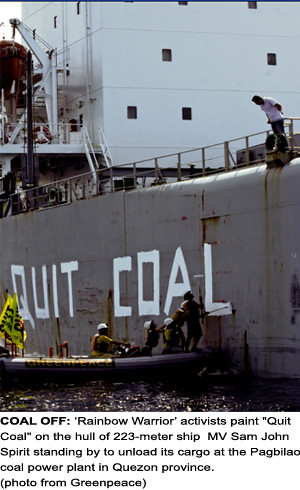
Activists paint 'Quit Coal' on vessel delivering shipment to power plant

The government currently has at least nine coal-fired plants lined up for construction or expansion in the country:including the 300 MW expansion in Masinloc, Zambales, 300 MW in Olongapo, Zambales

PAGBILAO, Quezon - Greenpeace activists aboard Rainbow Warrior, anchored alongside Pagbilao coal plant, painted the words ‘Quit Coal’ on the hull of a 223 meter vessel Sam John Spirit standing by to unload yet another shipment of thousands of tons of coal at Pagbilao power plant in the Philippines.

The Rainbow Warrior is in the Philippines on its “Quit Coal-Save the Climate" tour of Southeast Asia and the Pacific.

In a statement, the group said its ship has anchored alongside the said coal-fired power plant since Thursday to expose how coal causes climate change and to send a message that the Philippines should stop building and expanding harmful coal-fired power plants. The Pagbilao coal plant is one of nine currently in the government’s pipeline for either expansion or construction.

The Greenpeace ship’s anchorage was in no way impeding the unloading of coal currently ongoing at the plant’s wharf, or preventing the plant’s generating operations. The plant itself currently has enough stockpile to run uninterrupted for around a month. The activists painted a third coal shipment, Sam John Spirit, at anchor some four kilometers from the wharf. Greenpeace is sending a message that coal expansion should stop because of coal’s huge environmental costs.

“Enough is enough, there should be no more construction or expansion of coal fired power plants in the Philippines. We cannot allow our short-sighted government to burn our future. Pagbilao coal plant alone dumps as much as five million tons of the greenhouse gas carbon dioxide into the atmosphere every year. The more coal we burn, the lesser our chances are of effectively combating the climate change catastrophe," said Greenpeace Southeast Asia Campaign Manager Beau Baconguis onboad the Rainbow Warrior.

There are currently eight coal-fired power plants in the Philippines, with a total capacity of 4,177 MW, or about 26.1% of the country's installed capacity. Together, the coal plants already account for as much as 36% of the emissions from the energy sector.

However, the government currently has at least nine coal-fired plants lined up for construction or expansion in the country: the 300 MW expansion in Pagbilao, Quezon, 100 MW in Concepcion, Iloilo, 165 MW in Iloilo City, 200 MW each in Naga and Toledo Cities in Cebu, 300 MW expansion in Masinloc, Zambales, 300 MW in Olongapo, Zambales, 150 MW in Sultan Kudarat, and 200 MW in Saranggani.

“Clearly the national government is not serious about addressing climate change. You can’t stop a problem by abetting the cause," said Greenpeace Southeast Asia Climate and Energy Campaigner Jasper Inventor. “If the government wants to do right, the first thing on their list would be to quit coal and ensure there will be no more new coal construction and expansion. The government must then start phasing out of this dirty and dangerous power source while increasingly tapping clean, safe, renewable energy. Renewable energy sources are abundant in our country, the only thing we need more of is the political will to deploy them."

The energy sector is responsible for some two-thirds of world’s climate change-causing greenhouse gas emissions. Coal-fired power plants are the biggest offenders. Coal is the dirtiest, most carbon intensive of all fossil fuels. Coal emits 29% more carbon per unit of energy than oil and 80% more than gas. Carbon dioxide (CO2) is the main driver of climate change, representing a major portion of the world’s greenhouse gas emissions. Globally, coal accounts for almost 60% of carbon dioxide emissions from the power sector.

Environment ministers from G8 countries are scheduled to meet today with climate change on top of their agenda. Greenpeace is also calling on G8 countries to take real action against climate change, and deliver an Energy Revolution that makes coal the fuel of last resort.

The ship’s first port of call was Legazpi City, Albay, where the Governor of Albay declared the province a “no-coal zone" during a press conference onboard the vessel.

The Rainbow Warrior is in the Philippines to spearhead the Greenpeace “Quit Coal Tour" in Southeast Asia and the Pacific. The tour aims to promote solutions to stop climate change—an energy revolution away from the use of climate-damaging coal, and a massive shift to renewable energy. - GMANews.TV

Labels: , , , , , ,

Saturday, May 24, 2008

The Burning Coal Issue

Napocor gives a summary of imported coal deliveries for five coal-powered plants with an average price per MT of $50.15 as cost of coal and $15.39 as freight/delivery cost. These plants are located in Pagbilao, Quezon; Sual, Pangasinan; Naga, Cebu; Masinloc, Zambales and in Batangas.

Is the coal being purchased by the government for its power plants overpriced? This nagging question has been at the back of the public mind long before the outbreak of the controversy over the government’s plan to take over or change the management of the Manila Electric Co. and transfer it from the Lopezes to other power firms by breaking up its franchise?

Consumers are curious to know the truth because ultimately, they are the ones who suffer from any bloated price of coal which the National Power Corp. reportedly imports at a cost of about P20 billion a year. In Luzon, coal-fired power plants produce close to 35 percent of the total kilowatt-hours of power each year.

Some congressmen and cause-oriented groups have blamed a so-called Napocor mafia for the alleged overprice for which the latter allegedly get fat kickbacks from unscrupulous suppliers. Members of Congress have vowed time and again to investigate the alleged scam, but they have conveniently forgotten to do so up to now.

You must have read a one-page ad in the Business Mirror on May 12 showing that Napocor supposedly imports coal at $109 per metric ton while the Quezon Power Philippines Ltd. supposedly buys the fuel for only $64 per MT—a difference of $45. QPPL was identified by Winston Garcia, president and general manager of the Government Service Insurance System (which has 23 percent share in Meralco) as an independent power producer owned by Meralco. But Meralco corrected this by saying that QPPL is an American power firm.

The unmistakable inference is that Napocor’s coal import was fraught with anomaly. You can deduce this from the ad’s headline which asked “May Bukol ba ang Presyo ng Napocor Electricity?” In our local lexicon, the word, the word bukol is widely understood to mean kickback.

Note that the ad did not name the supplier and country from which the coal is purchased. Neither did the ad state the specific dates when the imports were made, or will be made, although it states that these were supposed to be in 2008. These data are important because the price of coal differs according to the source (Australia, China and Indonesia are the leading sources), and the date of importation, since the price also depends on the supply-and-demand situation prevailing at the time the coal is ordered.

Other factors that determine the price are weather conditions, freight rate and the availability of freight and related transport facilities. Those who placed this particular ad may have realized that the absence of these data could give rise to a credibility problem. And possibly because of this, another ad was published three days later, or on May 15, in the same business daily, this time focusing on 2007 coal imports.

This time, the ad cited specific dates of solicitation of supply. The given data put “Total Volume per metric ton” at 325,000 for March 29, 2007; 65,000 for April l8, 2007; and 64,000 for July 20,2007. What seems to be puzzling though, is that the costs given for the Contract Unit Price (US$/MT) were the same price for the three coal purchase transactions last year.

At the bottom of the ad, the price of coal bought by Napocor was again given at $109 per MT and that for the Quezon Power at $64 per MT—exactly the same prices cited in the first ad that supposedly dealt with the 2008 market situation.

The second ad also gives a supposed total overprice of P548.08 million for March 29; P50.16 million for April 18 and P78.11 million for July 20 involving the total contract price of P1.38 billion; P217.47 million and P245.26 million, respectively. The trouble is that those who prepared and placed the ad did not explain how they arrived at these figures. Did they expect the public to swallow these figures hook, line and sinker without explanation at all?

On the other hand, Napocor claims that for 2007, its average price index of coal imports per metric ton was $56.38 for Indonesia: $72.99 for China: and $64.82 for Australia.

Still for 2007, Napocor gives a summary of imported coal deliveries for five coal-powered plants with an average price per MT of $50.15 as cost of coal and $15.39 as freight/delivery cost. These plants are located in Pagbilao, Quezon; Sual, Pangasinan; Naga, Cebu; Masinloc, Zambales and in Batangas.

What was omitted or overlooked in the ads critical of Napocor was that the price, grade and quality of coal are major factors that determine the price of coal. These are things that only engineers and other technically equipped people can understand.

According to Napocor, the regional coal supply situation has lately become critical. This it attributes to the increasing demand for bituminous coal from India, China, Japan, Korea and Taiwan, among other factors. Indonesia’s reserves of bituminous coal are reportedly being depleted at an alarming rate. Changes in global weather have wreaked havoc on the production of coal in several coal-exporting countries. Snow storms have compelled China to impose an export ban on coal that was lifted only last March.

On the matter of prices, the world market price of coal in 2007 rose to more than $100 per MT. Reports said the price in the international market has shot up to $160 per MT this year.

Napocor has been severely criticized for failing to enter into long-term coal supply contracts when markets are calmer that would have resulted in huge savings.Why, it is often asked, does Napocor prefer to buy coal on a per shipment basis which naturally costs higher? This has fueled suspicion that this poor practice is resorted to because of the commission paid for every shipment delivered.

This is Napocor’s reply to this criticism: “While the power firm was forced to buy coal on per-shipment basis on certain situations, it has expressed preference for long-term contracts. It is seeking a review of its procurement policy to enable it to enter into such an arrangement for its five coal-fired plants.’

“It is true that long-term contracts may result in lower prices. Napocor is presently reviewing the policy to procure more than the existing 50 percent of its coal requirements through long-term contracts,” Napocor said adding that it will request for exemption from the Government Procurement Reform Act. Fel Maragay, First Crack - Manila Standard Today

Labels: ,


This is a joint private blog of volunteers from Subic Bay. It is being maintained primarily to collate articles that may be of importance to decision making related to the future of Subic Bay and as a source of reference material to construct the history of Subic Bay.

The articles herein posted remains the sole property of original authors and publications which has full credits to the articles.

Disclaimer: Readers should conduct their own research and due diligence before using any article herein posted for whatever intended purpose it may be. This private web log will not be liable for any loss or damage caused by a reader's reliance on information obtained from volunteers of this private blog.

www.subicbay.ph, http://olongapo-subic.com, http://sangunian.com, http://olongapo-ph.com, http://oictv.com, http://brgy-ph.com, http://subicbay-news.com, http://batanggapo.com 16 January 2012